Architects: Luis Izquierdo W., Antonia Lehmann S.B., Hernán Rodríguez V., arquitecto asociado. Alberto Rodríguez Cano, colaborador.
Structural engineering: Demetrio y Gonzalo Concha
Main contractor: Constructoras Mykonos, Belfi y Enrique Rawlins
Location: Santo Domingo Nº 1061, Santiago, Chile
Plot area: 1.850,66 m2
Built area: 5.037,81 m2 + 4.074,27 m2 subterráneos
Project: 1998
Construction: 1999
In January 1994 we were commissioned to design the head offices of the Gas Distribution Company of Santiago, Gasco, Chile’s oldest limited company. Its new headquarters, urgently needed at a moment of the company’s rapid growth and transformation, were to be built in the same site where GASCO had operated since its early days until then. The company was badly settled in various premises added successively to an old house in Santo Domingo Street. The house was to be kept as a traditional emblem and to remain in such address, in spite of it being located in an downtown area which had undergone progressive deterioration, at least until recent urban interventions, like the Centro Cultural Mapocho, together with the Parque de los Reyes and the eradication of the State Penitentiary, could bear their fruits of renovation. The property consisted of two adjoining plots occupying the entire length of the block. One of them faced Santo Domingo Street, and its front was occupied in all its width by the two story of the above-mentioned old house. The ground floor was destined to commercial premises and the second one, to the company’s management offices, which were accessed through a hallway leading to a reception hall surrounded by a disorganized group of semi-provisional office constructions, some blind and others open to small light patios. The other plot faced Rosas Street and had also a two storied house, although of inferior architectural worth, which had often been intervened in order to used its as office. Behind it this house there was a shed for parking cars and, at the back of the site, a fairly solid four- storied building, with a structure of reinforced concrete rigid frames.
The request program fitted the old house with 775 square metres, plus a new office building of 3,000 square metres, to be built next to it in the same site of Santo Domingo Street.
In order to make the site available for the new project, the staff working there had to be moved to the neighboring site with entrance through Rosas Street. This entailed a preliminary stage of reorganization and enlargement of the existing premises so as to increase the office capacity. The next stage, corresponding to the definite work, consisted in the old house restoration under the supervision of the architect Hernán Rodríguez V., and the construction behind it of the new office building.
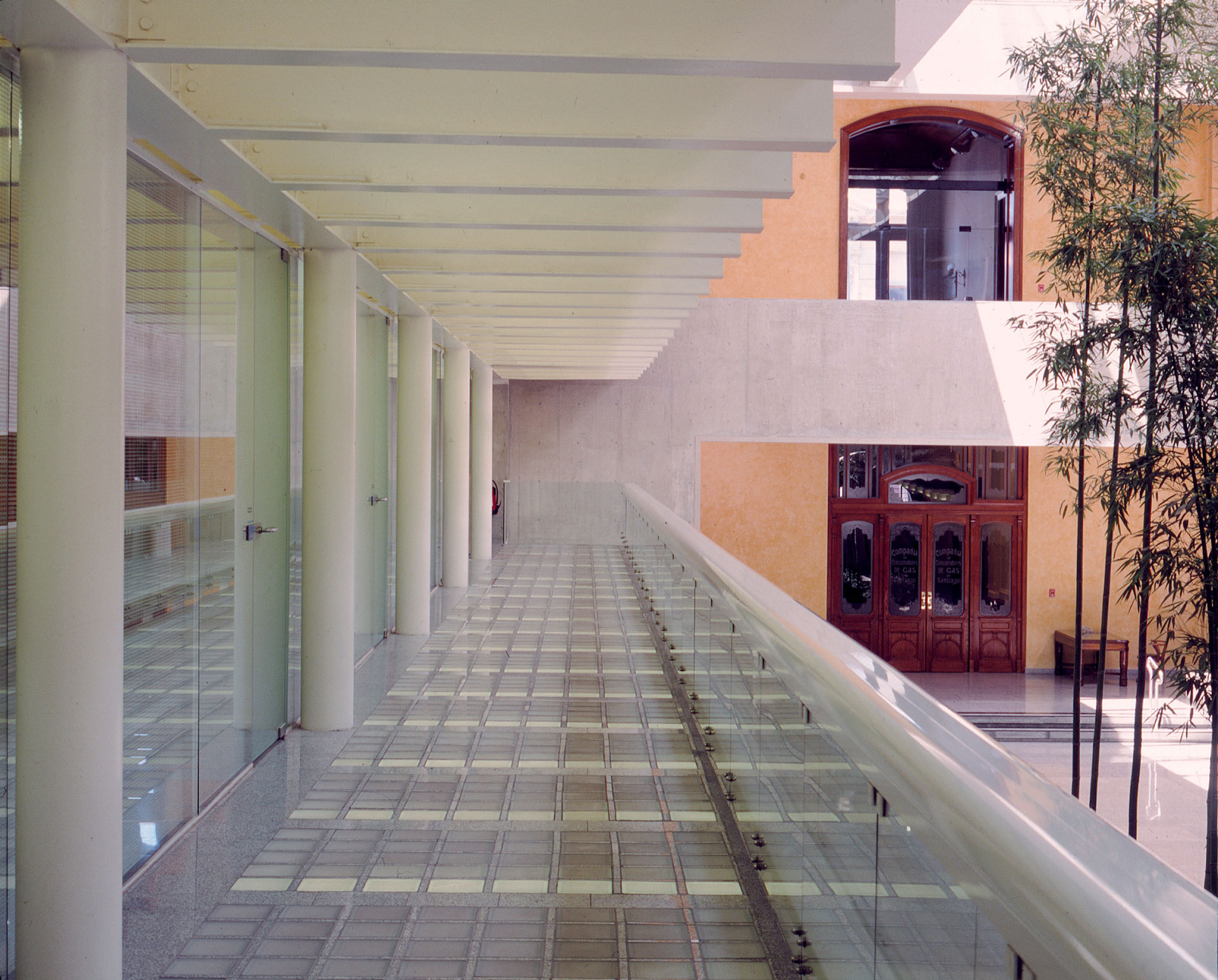
The old house dates back to the beginning of the 20th century and was design for the company by a non-identified architect, in a neo-renaissance and art nouveau electic style. It has two story high flights of simple bay, with a symmetric façade, with an outstanding stone doorway in the axis. This doorway gives access to a hallway ending in an open gallery (formerly an interior patio), in the north side, whose façade had faded after the construction out of semi-detached works. Against the eastern limit of the property, there is a narrow construction bearing the service entrance to what had formerly been a coach house, with transgressed the symmetrical order of the building.
The restoration work aimed at giving the building back the initial elegance of its architecture by means of recovering the original floor arrangement, ridding the façade of aggregated elements, reinforcing its structure and reconditioning the plumbing and the electric and air conditioning installations. An identical stair to the one existing in the west side was added to the eastern side of the gallery. The President’s offices, the Board of Directors’ conference room, and the lounge and dining room, which were completely redistributed and refurbished, were kept located on the first floor. The adjoining service facilities were rebuilt in order to include a kitchen and a lift.
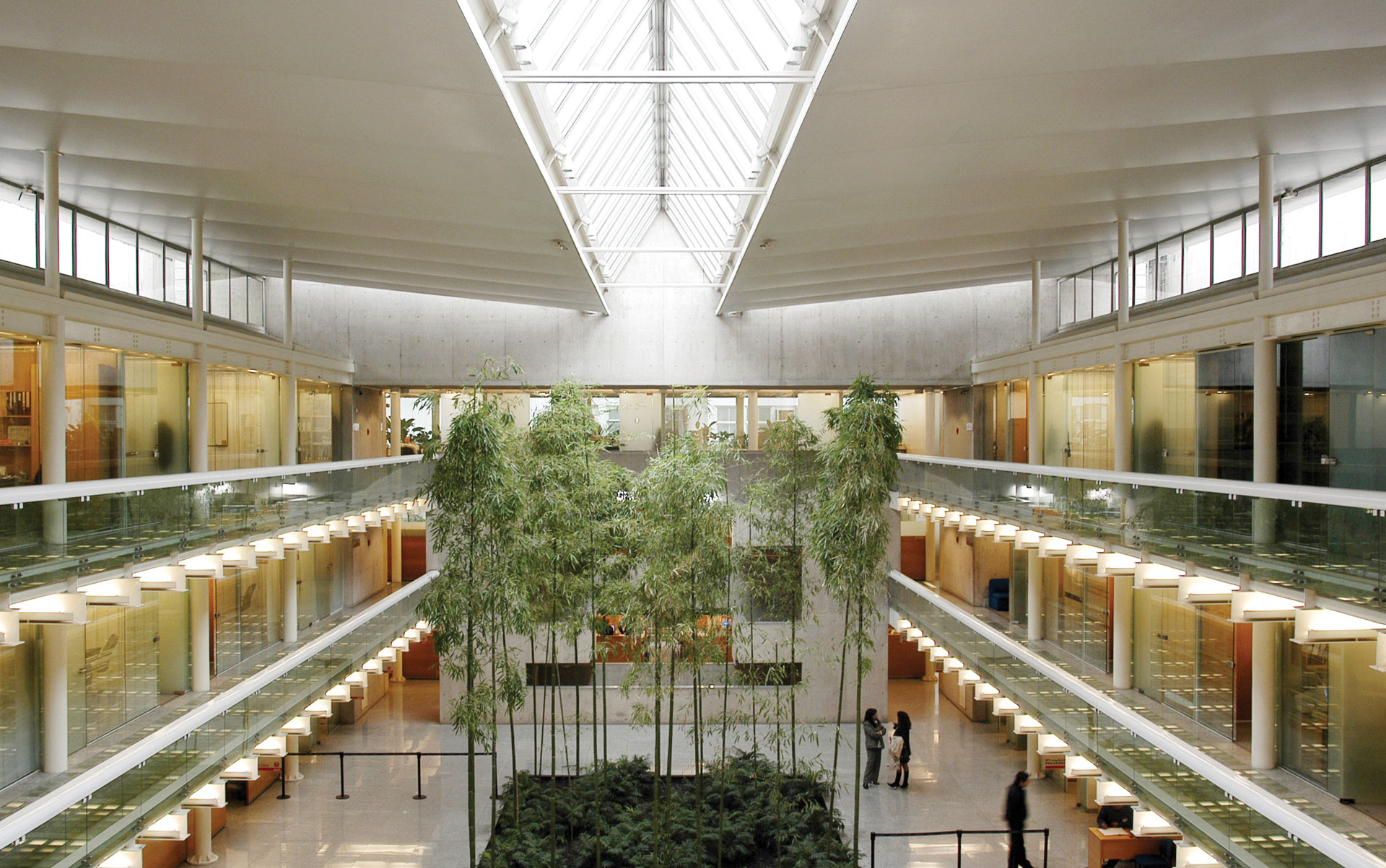
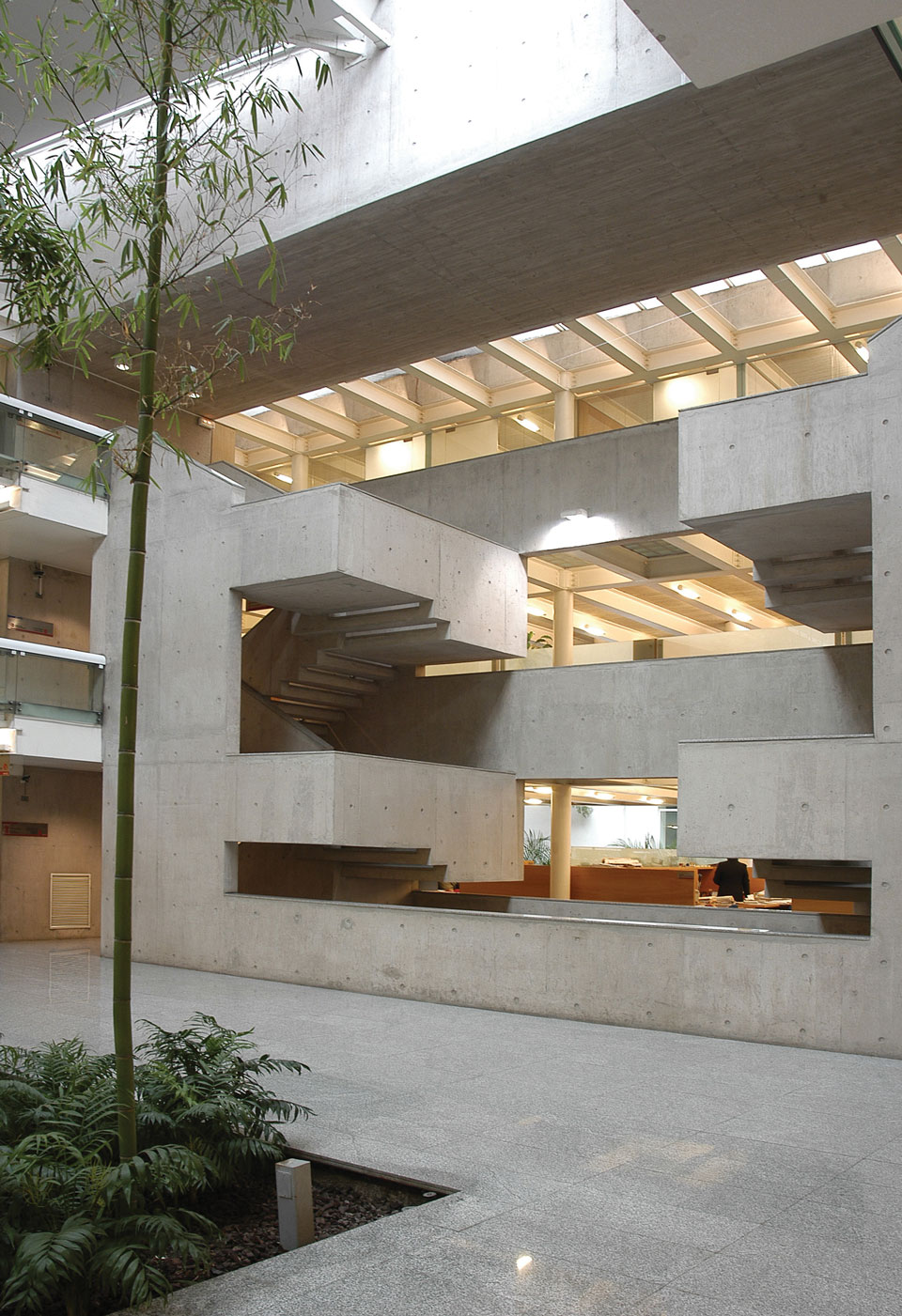
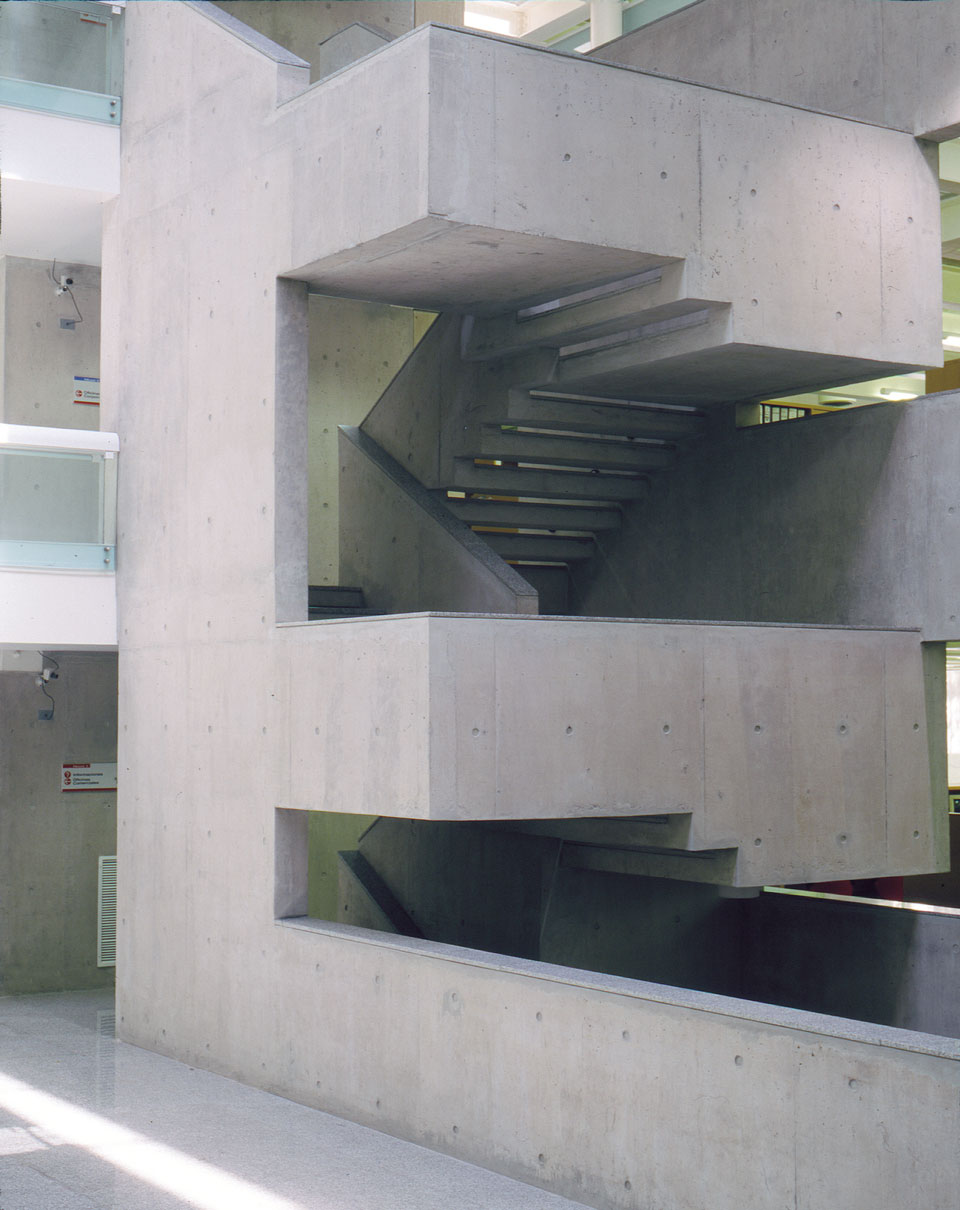
The site, which was cleared behind the old house, is 48 metres long by 29 metres wide. Seizing the possibility granted by the corresponding regulations of building against the whole length of the limits, and given the existing house’s height of 5.40 metres in between floor, the new building was designed in three stories, each of 2.88 metres in height. The ground floor was left a couple of steps below the existing access level, while the third floor was made to match the second floor of the old house, plus a intercalated mezzanine which coincides with the staircase landings. The floors follow a U-shaped, forming an inner space of 11 by 31 metres whose circulation -a balcony-like passage over this central hall, is closed up with the inclusion of the stretch corresponding to the old house gallery. The existing service body was prolonged up to the site’s eastern limit so as to include the necessary secondary staircases, elevators and archive storerooms, centering the office nave with respect to the axis defined by the existent entrance hallway, which now leads directly onto the larger space made up by the new building. Opposite to the vertexes of the rectangle where the old stairs stood, a pair of a new staircases were placed, rounding off the frontal vision of the hall along with the large frame resulting from the toilets and shafts nuclei, which hold the bridge bearing the air conditioning mechanical installations.
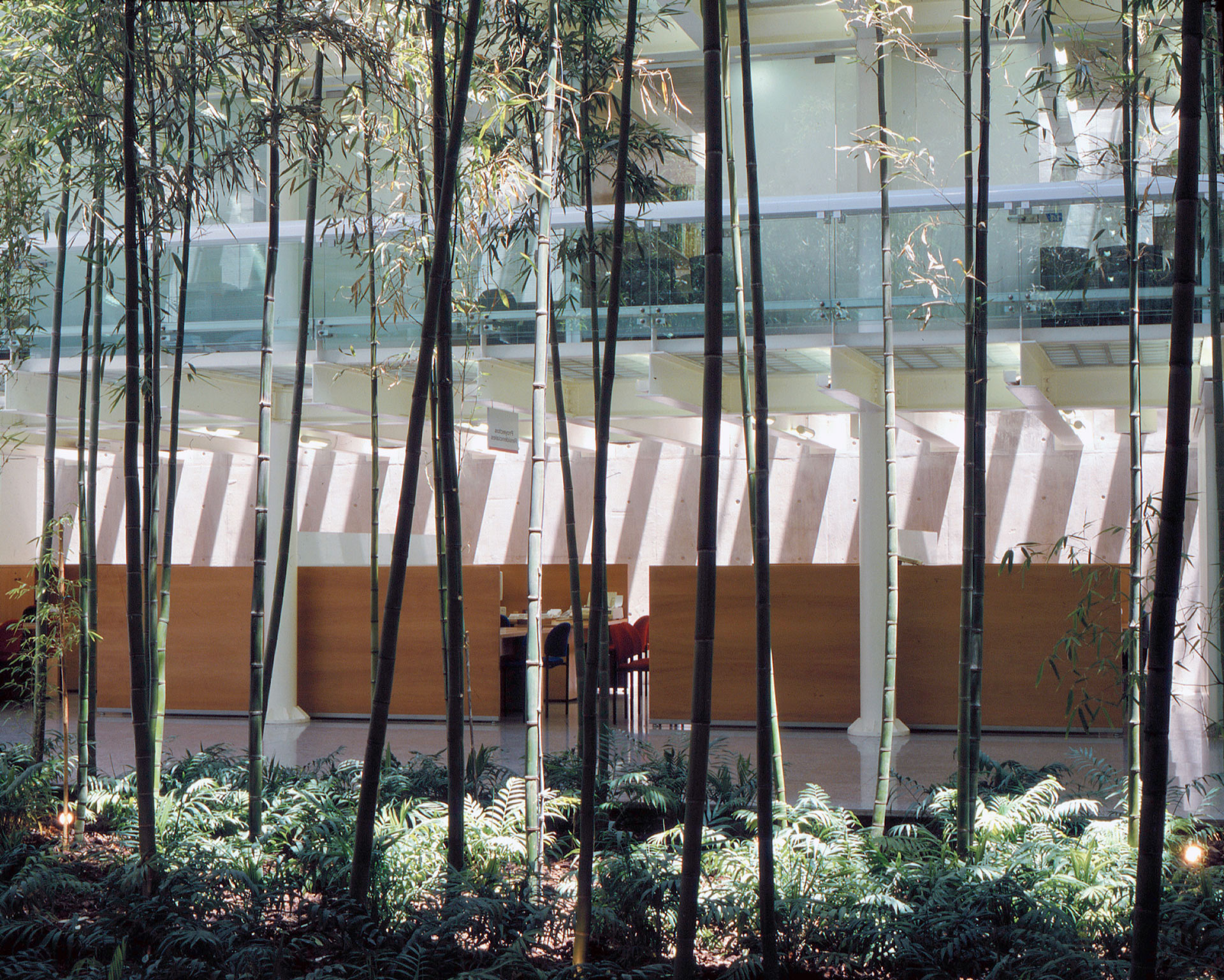
The symmetry of the composition is stressed by a central skylight running in a north-south direction along the row of roof trusses, which allows an oscillating narrow stripe of sun to fall over the gray granite floor and the vertical bamboo network in the hall’s garden. The planes of this central space’s ceiling open and closes mimicking the flights of birds. Sun entrances were also left of the perimeter walls, and the stories’ horizontal planes were separated from them so as to left them suspending within the larger space of the luminous box they delimited. Thus, the offices, both the one with glass panes and the ones open on its sides, are able to receive natural light from two sides. This double front opened to light is bigger in the central stretch of the floors with a deeper bay. These floor areas open toward a glass-covered back patio, planted with a thick garden, which lay in front of the existing building in the adjoining site with access through Rosas Street, whose windows also enjoy this green area. This patio enables the free availability of its neighboring property, so that without affecting the new building, it may eventually be sealed or be left for the future expansion of the company.
Considering the modest height of the its story, the speed of the construction and the desired architectural lightness, the new building was conceived with columns and steel floor and roof beams, leaving this metallic structure enclosed within a perimeter box made of reinforced concrete. The steel and concrete structures were left exposed in the architecture. As a measure of protection against fire hazards, the metallic elements were painted white, a colour chosen for its attributes of lightness and purity. The circulating aisles built above the central hall were made with glass block floors so as to be translucent.
Although the new building follows the symmetrical order pre-established by the old house, projecting it inwards the site, its architectural materialization, with its constructive bareness as well as its treatment of light, is decidedly modern. Thus, in an effort to characterize the corporate identity of the company proprietor of this building, a combination of tradition and innovation, past and future, matter and energy has been established.
Once the project was finished and is process of being put to tender, we were asked to do an extension, burying under ground three parking levels. This was possible of being accomplished without a significant modification of the upper floors thanks to the fortunate coincidence of the existing distances between columns and the modulation required in the underground levels for their adequate performance. The parking had to be accessed from Rosas Street, by means of a ramp that leads to the underground premises of the neighboring building, which has granted Gasco an easement access.
Bibliography
IZQUIERDO, L., LEHMANN, A. Edificio Gasco. En: Arquitectura reciente en Chile. Las lógicas del proyecto. Chile, Ediciones ARQ. Escuela de Arquitectura. Pontificia Universidad Católica de Chile. Serie Difusión Arquitectura / Volumen 4, 2000. pp. 132-139.
Edificio Gasco. En: XII Bienal de Arquitectura 2000. Arquitectura de uso público: reinventar el futuro. Chile, Colegio de arquitectos de Chile, 2000. pp. 154-155.
IZQUIERDO, L., LEHMANN, A. Luis Izquierdo y Antonia Lehmann. En: Documentos del colegio de arquitectos de la USFQ. V Foro Internacional de Arquitectura: La nueva Arquitectura de Chile. Ecuador, Colegio de arquitectos de la USFQ, Universidad San Francisco de Quito, 2004. pp. 62-81.
IZQUIERDO, Luis. Cielo desplegado: Edificio Gasco. CA: Ciudad y Arquitectura (102): 44-49. Chile, Julio-Agosto-Sep. 2000.
Edificio Gasco, por el premio nacional de arquitectura: Luis Izquierdo y Antonia Lehmann. Casa & ambientes: 36-39. Chile, Septiembre 2004.
MORAGA, Jorge. Levedad entre 4 paredes. Ambientes (15): 32-35. Chile, Mayo-Junio 2000.
HAGEBRAND, Pablo. Izquierdo y Lehmann: dos edificios recientes. Nuevo Diseño (2): 42-47. Chile, Junio-Julio 2002.
Izquierdo, Lehmann, Cía., Arquitectos. En: AOA. Asociación de Oficinas de Arquitectos 05. Chile, Publicación de la Asociación de Oficinas de Arquitectos, 2005. pp. 172-175.
LARRAIN, María Paz. Luis Izquierdo y Antonia Lehmann. Ed (60): 48-52. Chile, Noviembre 2000.
HEIM, Patricio. La fórmula del éxito. Cultura urbana: 62-69. Chile, Marzo 2002.
FRIEDMANN, Eileen. El binomio de la arquitectura. Ambientes (36): 48-51. Chile, Noviembre-Diciembre 2003.
CASTILLO, Eduardo, Conversaciones informales. Germán del Sol - Luis Izquierdo. Ediciones ARQ. Serie Palabra, 2009.